Now that I’m mostly recovered from my hernia surgery, I’ve had to rethink my approach to strength and conditioning for BJJ. I love lifting heavy and performing grueling conditioning programs as they make me feel young and alive, but I’m now realizing that this approach simply isn’t sustainable. Now that I’m in my mid-50’s, I need to accept that I’m more injury prone and that it’s time to adapt accordingly. In this post, I’ll highlight some of the changes I’ve been making with the hope that this can be of some assistance to other practitioners who are middle aged and up.
Training Goals
I’ve found that it’s now necessary to be more focused with regard to my strength and conditioning goals. It’s no longer enough to train for some vague purpose like lifting as heavy as I can or having the heaviest deadlift I can manage. It’s time (and it should always be time) to be very specific about the purpose of strength and conditioning training. Truth be told, Jiu Jitsu doesn’t require all that much strength, though having strength can be helpful. And the cardio needed is very sport specific, so I now have other reasons for my training.
For starters, I continue my strength and conditioning training to help my body age gracefully. While longevity is fantastic, it’s important to me for those years to be of high quality. We can’t change our genetics (at least for now), but we can take precautions to prevent things like osteoporosis, dementia, heart disease, and other ailments that often affect older generations. Other goals include increased mobility, injury prevention, and of course, gaining a slight advantage in BJJ.
Training Modalities
While I love powerlifting, even if I’ve never achieved a high skill level with it, I’m realizing that it’s no longer suitable for me given my history with hernias. Also, I question whether it’s the most effective program for this stage in my life. That said, I love that it focuses on compound movements which train many muscle groups simultaneously, and I use that model to choose how I structure my strength program.
At this stage in my life, I prefer to use moderate weights and to do so in the form of bodyweight exercises, kettlebells, and resistance bands. I also sometimes incorporate yoga and Animal Flow type movements. I don’t concern myself with going as heavy as I can or even performing as many reps as I can. Instead, I focus on a rep range which offers some degree of difficulty without placing too much stress on my body. Jiu Jitsu already provides enough stress, so I prefer to use my strength training to maintain strength, perhaps to develop a bit more, and to focus on maintaining muscle mass, mobility, and on injury prevention.
The Actual Exercises
For my BJJ strength and conditioning program, I’ve borrowed from the StrongLifts 5×5 program by focusing on incorporating the major movements into my training program: horizontal push, vertical push, pull, squat, and hip hinge. I choose to vary the exercises I use for these movements as my method to place additional stress on my body rather than going very high in weight or rep count.
An example of the exercises I might use for this program might include pushups, kettlebell overhead presses, kettlebell bent over rows, body weight squats, and kettlebell swings. On any given day, I can easily vary the workout by adjusting the balance between body weight and kettlebells, programming some of the exercises into a complex, or substituting resistance bands. This allows me to easily adjust depending on how I’m feeling that day, how much time I have, or my location (in the case of travel). I’ve gotten great workouts in hotel rooms and on cruise ships as a result of my flexibility.
Fitting Strength Training Into My Schedule
I choose to use a technique that Pavel Tsatsouline calls “greasing the groove”, which means that I do a little bit of my workout in small pieces all throughout the day. This enables me to be fresh each and every set and to be flexible with regard to how and when I time my workouts.
Typically, I’ll begin each day with a circuit before breakfast. 3x per week, I’ll do a complete circuit as soon as I head downstairs to start my day. This puts me in a healthy mindset at the start of the day and leaves me with a feeling of accomplishment at already having completed some of my workout.
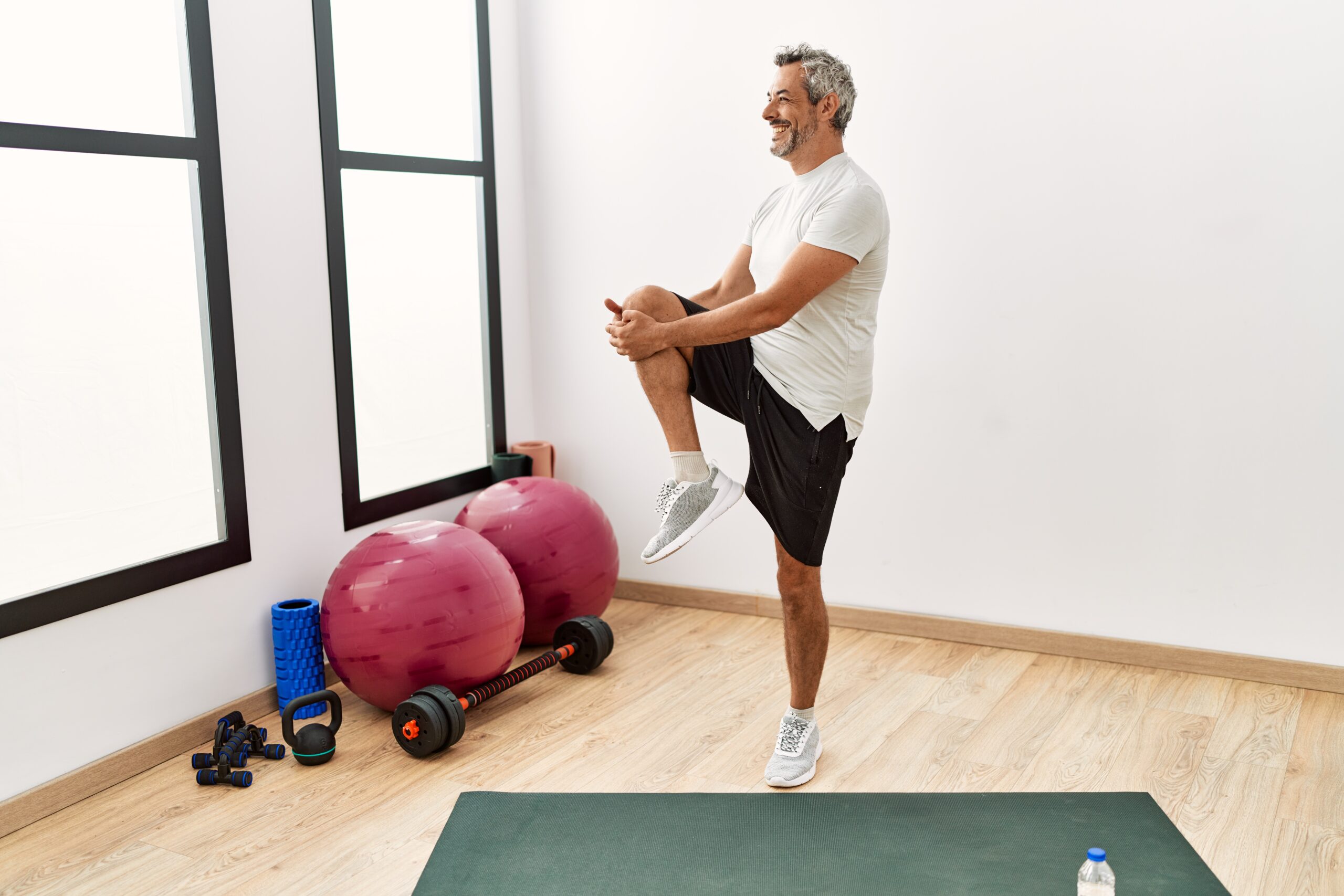
As I’m the only person using my office, I’m able to keep a pullup bar, resistance bands, several kettlebells, a yoga mat, and a foam roller there. This way, I can continue to workout throughout the day. Whenever possible, I use my standing desk so I can avoid sitting for long periods throughout the day. And whenever I get up to use the bathroom, I complete another circuit when I return. As I drink a lot of water throughout the day (about 100-120oz each day), I easily use the bathroom enough times to get in 4-5 circuits. I like to structure my rep ranges to enable me to do my entire workout in no more than 5 circuits. Then I’ll use the rest of the workout for stretching and mobility work.
I recently learned that there is a dance studio on the first floor of the building where my office is located and that this studio offers yoga classes several times a week. I’ve recently begun popping in once per week or so for a class, which has been fantastic for my mobility as well as my recovery from a recent hip flexor strain. It’s incredibly convenient to simply throw on a pair of gym shorts, grab my yoga mat, and walk downstairs to the class.
I admittedly don’t do too much for conditioning, but when I do, it usually consists of walking or rucking. I’m fortunate enough to be able to walk to work, so I’ll often leave a bit earlier than is necessary to take a longer route to the office. This enables me to get in some light rucking as I’m wearing my backpack before work. If I walk fast enough, then I can arrive at the office having already completed 15-20 minutes of exercise. Add to this my walk home for lunch, the walk back to the office, and a brief brisk ruck after work and I’ve got my conditioning covered.
It’s absolutely essential for older grapplers to program active recovery days into their routine. Yoga classes, walking, and even rucking are excellent options.
Mobility and Flexibility
Now that I’m in my mid-50’s, I’ve been focusing more on mobility and flexibility. I’ve recently begun working more with my personal trainer, Matthew Flaherty of Stafford Strength. Matt has been introducing me to programs such as Flexible Steel and Ground Force Method, both of which have been incredibly beneficial. I’m also looking forward to incorporating some Indian Club work, and I plan to ask Matt for his guidance as this is one of his areas of expertise.
I generally try to incorporate a full body mobility and flexibility routine every day, though I go deeper into it on days when I’m not doing strength training. These days, I focus a lot on movements which will either stretch or strengthen my hip flexors in order to assist with the healing process. I also focus a lot on the lower back and the hips as these are the areas most impacted by sitting at my desk (since I don’t always want to stand for 8-12 hours per day) as well as by Jiu Jitsu.
Equipment Needed
The fantastic thing about this approach is that it requires minimal equipment which can be purchased for less than the cost of a few months of a gym membership, at least based on what the typical gym membership costs here in the New York City area. I’ll list some of the most important pieces of equipment below:
Kettlebells
I find that a great option is the Amazon Basics Kettlebell, available on Amazon for an extremely reasonable price and in a variety of weights. The handle is easy to grip and the shape is ideal for performing the classic standard kettlebell exercises. I have several of these in various weights that I’ve owned for over ten years and they’re all still doing great.
Resistance Bands
For resistance bands, I use the bands sold by the Bob & Brad physical therapy team. As I get a lot of benefit from watching their YouTube channel, I wanted to support them, so I spent a bit more to purchase their product. The Bob & Brad Resistance Bands happen to be a very well made product and come in enough resistance variations to enable anyone to use them for a great workout.
Pullup Bar
I prefer a freestanding pullup bar as it’s much safer than those that mount in a doorway. I’ve tried several varieties of the door mounting type and I always felt like I was risking the possibility of it falling. The Soges Tower Pull Up Bar Station is easy to assemble, feels rock solid, offers handles for doing bar dips, and doesn’t take up too much space.
Yoga Mat
There are many options for yoga mats available, so this one doesn’t need any overthinking. Something simple that comes with a strap or carry bag such as the Gruper Yoga Mat will work perfectly.
Indian Clubs
Even though I’ve not made Indian Clubs a regular part of my routine, I still sometimes do a few exercises with them to help with shoulder health. I found a set of lightweight clubs on Amazon that I like to use, and considering the very reasonable price, I was amazed at the excellent quality.
Foam Roller
I’ve used several foam rollers over the year but my favorite by far was the inexpensive Amazon brand foam roller, available in multiple lengths. It’s probably the least expensive foam roller I’ve ever used and it’s the perfect size and density to allow me to attack all of my most problematic areas. And it’s so inexpensive that if it gets lost or damaged, I don’t have to worry about it and can just order another one without giving it a second thought.
Summary
It’s incredibly easy to assemble a strength and conditioning routine that’s very effective, easy to fit into a busy schedule, and which suits the needs of older practitioners. Not needing to focus extensively on lifting heavy and instead focusing on maintenance, mobility, and flexibility offers many more possibilities and options over trying to incorporate a traditional power lifting program or other types of more intensive lifting. I also love the flexibility of such a program as it enables me to easily adapt when traveling or when my schedule gets busy.
I’m finding more and more that the most effective strength and conditioning routine for older athletes is one that doesn’t leave the athlete overly vulnerable to injury, aids with Jiu Jitsu performance, and which helps to prevent injuries while on the mat. Consider lifting lighter, doing more bodyweight and kettlebell workouts, and including more mobility and flexibility in your strength and conditioning routine for better results as you age.
To view the Amazon Basics Kettlebell on Amazon, click here.
To view Bob & Brad Resistance Bands on Amazon, click here.
To view the Soges Tower Pull Up Bar Station on Amazon, click here.
To view the Gruper Yoga Mat on Amazon, click here.
To view Ultimate Body Press Indian Clubs on Amazon, click here.
To view Amazon Basics High Density Foam Roller on Amazon, click here.
BudoBelly is a participant in the Amazon Services LLC Associates Program, an affiliate advertising program designed to provide a means for us to earn fees by linking to Amazon.com and affiliated sites.