If you’re over 50 and thinking about starting (or continuing) a martial art, Brazilian Jiu Jitsu and boxing are two excellent choices. Both can provide challenging workouts, teach genuine fighting skills, keep the brain engaged, and introduce you to a community of people who enjoy testing themselves physically.
I’ve trained extensively in both. I spent over a decade training Brazilian Jiu Jitsu, and I currently train boxing. I have a tremendous amount of respect for both sports. But as I’ve gotten older, I’ve also become much more interested in a different question:
Which martial art is easier to adapt to an aging body?
Based on my experience, when comparing boxing vs BJJ after 50, the answer has increasingly become boxing.
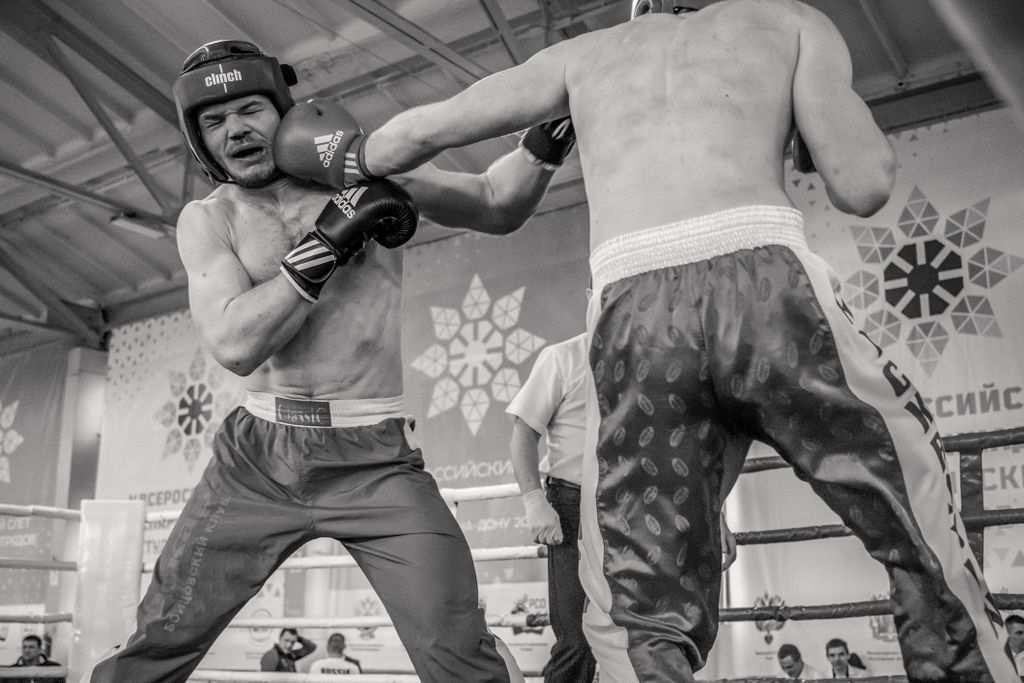
That’s not because boxing is inherently safer or easier. Getting punched in the head obviously introduces a risk that doesn’t exist in quite the same way in BJJ. But when boxing is approached intelligently, particularly when hard sparring is limited or eliminated, I believe it may offer older athletes more control over how much stress they put on their bodies while retaining most of the benefits that make martial arts so rewarding.
BJJ Gives You Something That’s Hard to Replicate
One of the greatest things about Brazilian Jiu Jitsu is that you can experience what it’s like to go against a genuinely resisting opponent. You aren’t simply performing techniques while your partner cooperates. When you roll, the other person is actively trying to prevent you from succeeding while simultaneously attempting to impose his or her own game on you. That creates a kind of physical problem-solving laboratory.
And because full-force striking isn’t involved, practitioners can regularly test their skills against resistance in a way that is difficult to duplicate in most striking arts.
That’s one reason BJJ can remain so compelling for decades.
BJJ Can Also Be Hard on an Older Body
The downside is that grappling can be very demanding on the joints and back.
BJJ asks the body to twist, bend, compress, pull, push and support weight from positions that don’t always resemble conventional everyday movements. It can also require a level of flexibility that many people over 50 simply don’t possess when they first walk into a gym. At my age, I have no expectations of inverting and pulling off a successful berimbolo while rolling. I’ve certainly tried, and quickly learned that no amount of practice would enable me to make the move part of my grappling vocabulary. That said, when such positions are taught in class, I approach them in earnest due to the physical and cognitive benefits of training them, and because I need to have knowledge of them to be able to counter them while rolling against athletes who use them.
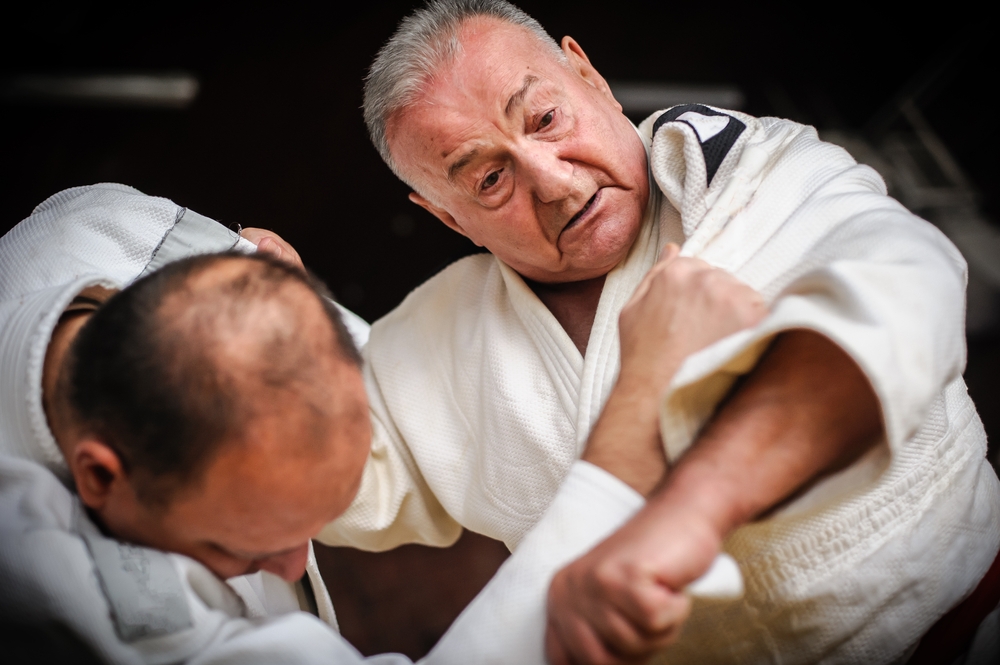
The good news is that BJJ can be adapted to an enormous range of physical abilities. Your game doesn’t need to look like that of a 22-year-old competitor. An older practitioner can develop techniques and positions suited to his or her own mobility, strength and physical limitations. I’ve found it helpful to identify the core techniques that work well for my body and to focus my efforts there. For many older athletes, that can often mean focusing on very traditional “old school” Jiu Jitsu techniques rather than a deep exploration of modern sport Jiu Jitsu. Many older practitioners also find it helpful to incorporate a game that favors a top-heavy pressure focused game, though it’s also essential to be strong at escaping bottom positions such as bottom mount, side-control, knee-on-belly, and sweeps from various bottom guard positions.
Even with modifications to your BJJ game, recovery becomes increasingly important. When I trained BJJ, I learned that I needed to be particularly mindful about warming up and cooling down. If I wasn’t, I would frequently experience significant back pain afterward.
And this brings up something I think older grapplers need to recognize:
The standard BJJ class warmup may not be enough for you.
A few minutes of jogging, shrimping and basic movements might adequately prepare a younger athlete for class. An older athlete may need considerably more.
That can mean arriving early and performing your own mobility and warmup routine before class even begins. The same principle applies after training. Spending a few additional minutes cooling down and working on mobility may make a substantial difference in how you feel the following day.
At this age, preparation and recovery are part of training.
The Unpredictability of Rolling Matters More After 50
Another challenge with BJJ is that you don’t completely control what happens during a roll. You can control your own intensity, but you can’t completely control your partner. A gentle roll that escalates, especially with an inexperienced younger grappler, can easily spiral out of control, especially when ego gets in the way. I can remember one such roll in which I caught a young blue belt in a Peruvian Necktie. For a second, he appeared stunned, possibly because as a 20-something former college wrestler, he wasn’t expecting to be submitted by a 50-something hobbyist. He immediately went into full competition pace. While the roll didn’t feel so safe or even friendly at that point, there was very little time left, so I simply focused on staying on top and controlling him, but I’m at a point in my life now where I’d prefer to simply stop the roll than risk continuing at such a pace with someone 30 years my junior simply out of ego.
It’s exactly this type of unpredictability that is part of what makes grappling so useful and exciting. It’s also one of the things that can make it harder on an aging body. For older BJJ practitioners, choosing training partners wisely becomes extremely important.
The ideal partner isn’t necessarily the least skilled or smallest person in the room. Often, an experienced practitioner with excellent control is a much better partner than an athletic beginner who doesn’t yet understand how to regulate intensity. One of my favorite training partners was a 230 pound six foot tall former USMC officer who was also a Judo black belt. He taught me a valuable lesson. At age 54, he showed up 5-6 days per week to train, but he rolled at a gentle pace and never let ego enter the equation. I always felt safe while rolling with him, and I always learned from those rolls. He taught me that staying safe and injury free to be able to show up the next day to train is far more important than “winning” the round.
There is no prize for surviving every roll in the gym. Longevity requires learning when to roll hard, when to slow things down, whom to train with and when to sit a round out.
BJJ Competition Can Continue Surprisingly Late in Life
One enormous advantage of BJJ, however, is that meaningful competition can remain accessible well beyond the age when most people think of themselves as competitive athletes. I’ve known BJJ competitors who continued competing successfully into their 70s. I even met one competitor who competed with a pacemaker.
That says something remarkable about the adaptability of the sport.
Competition obviously isn’t appropriate for everyone, and individual medical circumstances need to be considered. But BJJ provides older practitioners with opportunities to continue setting goals, testing their skills and experiencing genuine competition at ages when many other competitive sports have long since disappeared from their lives. For some people, that alone is enormously valuable.
I do know boxers who compete in their 50’s, and there’s even a 74 year old at my boxing gym who competes, but deciding whether to compete at this age is a deeply personal decision, and it’s certainly possible to enjoy many of the benefits and much of the enjoyment of boxing without competing.
Why I’ve Come to Appreciate Boxing After 50
I recently made the transition from BJJ to boxing, and one of the things I’ve come to appreciate most is how easily I can regulate my training.
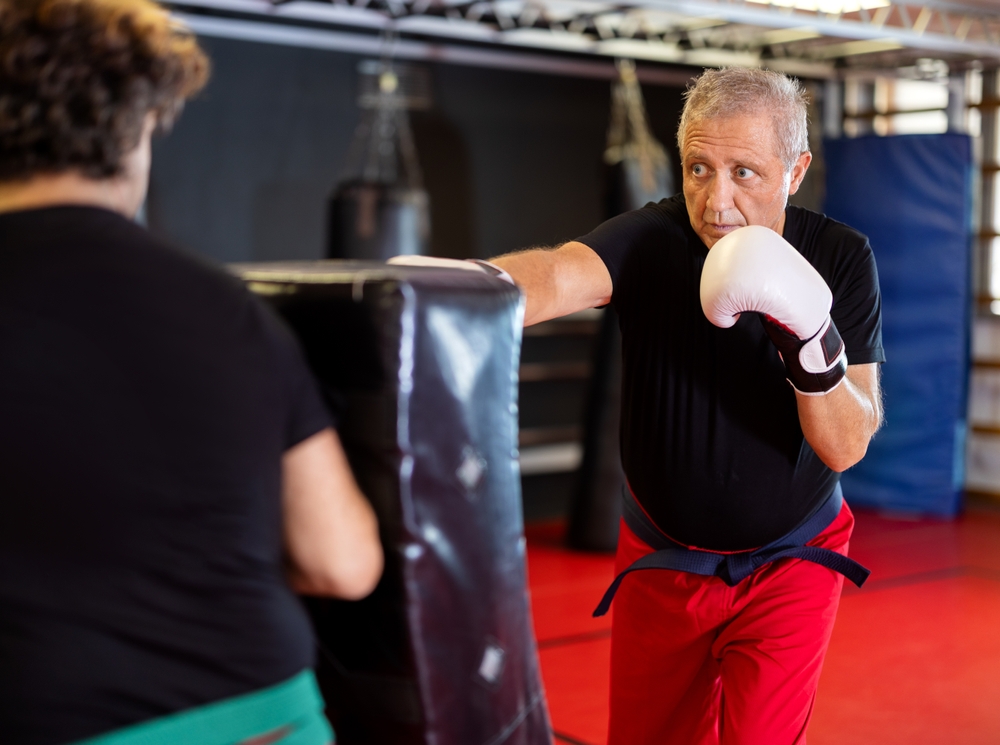
Boxing doesn’t have to mean walking into a gym and fighting someone during every training session. On one day I can focus on the heavy bag. Another day might involve shadowboxing, footwork, jump rope or defensive movement. Another session might include mitt work or partner drills. Then I can incorporate controlled technical sparring when appropriate.
That creates an enormous number of ways to adjust training according to how my body feels on a particular day. If I’m tired or sore, I can have a productive skill session without subjecting myself to a highly demanding workout. If I’m feeling great, I can increase the intensity.
I can also build a weekly schedule that deliberately balances independent skill training with classes, partner drills and light sparring.
For an older athlete, I consider that flexibility a major advantage.
The Head-Trauma Question Can’t Be Ignored
Any discussion of boxing after 50 needs to address the obvious issue: head trauma. Repeated blows to the head carry risks, and those risks shouldn’t be dismissed simply because we enjoy the sport. That’s why I think older recreational boxers should make deliberate decisions about how much contact they actually need.
Hard sparring isn’t necessary to obtain most of what boxing has to offer. Partner drills and light technical sparring can develop timing, distance, defense, reactions and the ability to work with another person while dramatically reducing the amount of punishment involved compared with frequent hard sparring.
You can still learn to box, become more technically proficient, experience the challenge of working with another boxer, and enjoy the camaraderie and culture of the boxing gym.
Whether to participate in hard sparring or actual competition is a much more personal decision. For many people over 50, it may simply not be necessary. Former Olympic boxer Tony Jeffries talks about this at length on his YouTube channel, and offers many valuable alternatives to hard sparring that enable boxers to acquire skills while minimizing the risk of head trauma.
Boxing Trains Qualities We Need as We Age
Another reason I’ve become enthusiastic about boxing is how many of its basic movements correspond with physical qualities that become increasingly important as we get older.
Footwork challenges balance and coordination, punching requires rotation through the body, and moving around the ring requires us to change direction, shift our weight and maintain our posture while performing another task. Training rounds challenge cardiovascular fitness.
Weight-bearing movement, strength training associated with boxing, and other appropriate exercise can contribute to maintaining the musculoskeletal qualities we need as we age. And boxing constantly demands coordination between the eyes, brain, hands and feet.
BJJ offers many of these benefits as well, of course. In some areas it may have an advantage. Grip strength is an obvious example. Anyone who has spent time grappling with a strong gi player knows just how much the hands and forearms get trained. Another benefit is flexibility and mobility. After age 50, the degree of flexibility and mobility required to play Lasso Guard becomes much more obvious than it might to a 23 year old.
Both sports force the body to do considerably more than simply repeat the same movement on a piece of cardio equipment.
Don’t Forget What These Sports Do for the Brain
One of the biggest reasons I advocate martial arts for people over 50 has nothing to do with fighting. It’s the learning, which helps with cognitive development and neuroplasticity.
There is almost always something new to learn during a boxing or BJJ session. In boxing, you might work on a new combination, change the angle of an attack, improve a defensive movement or learn to recognize what an opponent is doing. In BJJ, you might learn a new sweep, submission, escape, transition or tiny adjustment to a position you’ve already practiced hundreds of times. Both sports combine cognitive work with physical movement.
You’re developing hand-eye coordination, balance, timing, spatial awareness and the ability to move your body through a wide variety of positions. You’re solving problems while physically tired. You’re remembering sequences and learning to react to changing circumstances.
There is also the social component. A good martial arts gym provides something that’s increasingly easy to lose as we get older: a community built around doing difficult things together.
You develop relationships with coaches and training partners, and those relationships are an underrated part of martial arts training.
So Which Is Better After 50: Boxing or BJJ?
I don’t think there is a universal answer.
If you love grappling, BJJ can potentially remain part of your life well into old age. Choose your partners carefully, develop a game suited to your body, take warming up and recovery seriously, and resist the temptation to train like the youngest competitors in the room.
But having trained both, and having recently transitioned from BJJ to boxing, I’ve come to believe that boxing may have a slight advantage as an age-friendly martial art when the training is appropriately modified.
The reason is control. I can decide how hard today’s boxing workout needs to be. I can train alone when I need to, I can work technique without sparring, I can use partner drills and controlled technical sparring when I want interaction, and I can choose whether hard sparring or competition has any place in my training at all.
That ability to continuously adjust the sport may become increasingly valuable with every passing decade.
BJJ gives you the extraordinary experience of regularly testing your skills against a fully resisting opponent, and it remains one of the most intellectually fascinating physical activities I’ve ever experienced.
Boxing gives me something slightly different: the ability to preserve much of what I loved about martial arts while exercising greater control over the physical price I pay for training. And after 50, that may be the most important consideration of all.
The best martial art isn’t necessarily the one that gives you the hardest workout or makes you the toughest person in the room.
It’s the one you can still be excited about training tomorrow, and hopefully for decades to come.