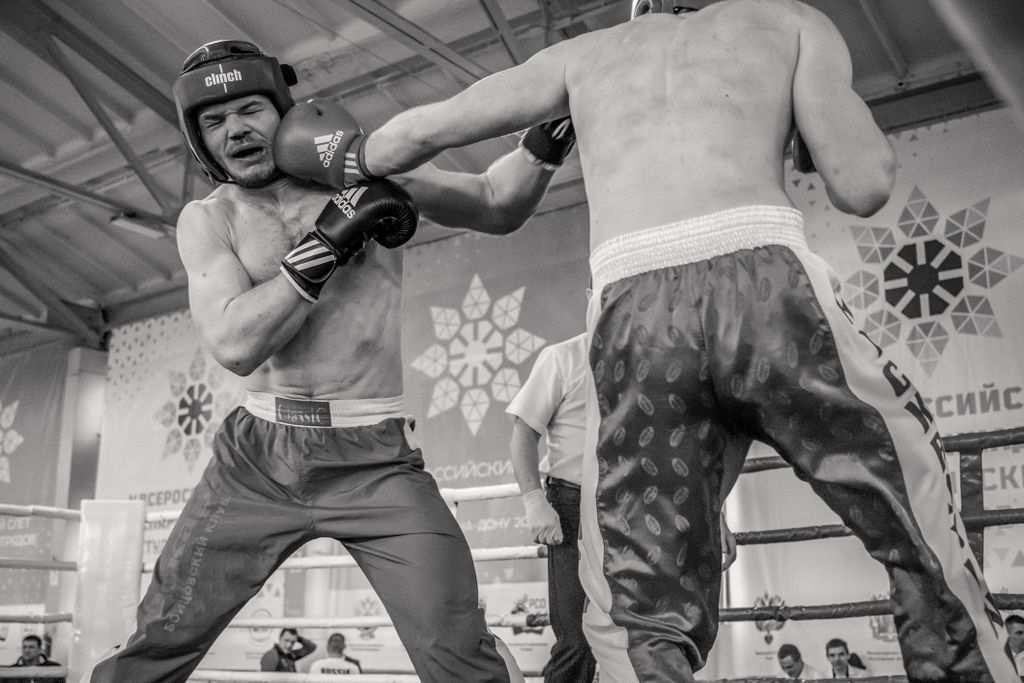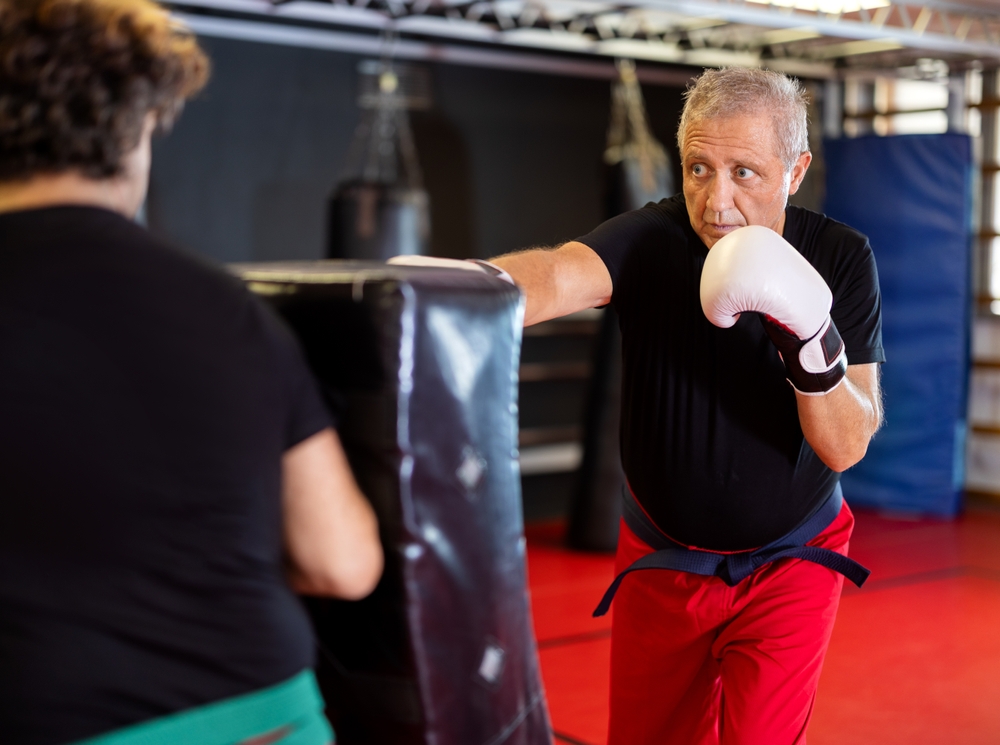
When discussing which martial arts are most effective for self-defense, the debate often comes down to striking versus grappling. Boxing, Muay Thai, Brazilian Jiu Jitsu, wrestling, and other combat sports all offer valuable skills that can help someone defend themselves in a physical confrontation. But I believe the discussion changes considerably when we’re talking about people over 50.
I’ve spent a little over a decade training Brazilian Jiu Jitsu, along with time spent training Muay Thai, and more recently, boxing. I’ve experienced firsthand the strengths and limitations of both striking and grappling arts, and I’ve come to believe that striking-based martial arts may offer some significant advantages for older adults interested primarily in self-defense.
This isn’t to suggest that grappling is ineffective, or that everyone over 50 should abandon Brazilian Jiu Jitsu in favor of boxing. Quite the opposite. I believe grappling skills are extremely valuable, and there are situations in which they could save your life.
However, as we get older, our priorities in a physical confrontation should change. Rather than thinking about how to defeat or control an attacker, we should be thinking about how to minimize our exposure to injury, create an opportunity to escape, and get home safely.
Here are seven reasons why I believe striking arts may be particularly well suited to that objective.
1. Going to the Ground Becomes Increasingly Dangerous With Age
One of the fundamental differences between striking and grappling is that grappling frequently involves taking an opponent to the ground and controlling them from there.
In a Brazilian Jiu Jitsu academy, this makes perfect sense. We’re training on padded mats, in a controlled environment, with partners who are generally trying to avoid seriously injuring us. The street is an entirely different environment.
Concrete, asphalt, curbs, stairs, and other hard surfaces create significant hazards, particularly for older adults. A fall that might result in a few bruises for a 25-year-old could have much more serious consequences for someone in their 50s, 60s, or 70s.
As we age, changes in bone density, balance, mobility, and our ability to recover from injuries can make falling increasingly consequential. And once we’re on the ground, we’re also more vulnerable to additional attackers, weapons, and environmental hazards.
For these reasons, I believe one of the most important self-defense priorities for older adults should be to remain standing whenever possible.
2. Strength Can Play an Outsized Role in Grappling
One of the great benefits of Brazilian Jiu Jitsu is that it teaches smaller, weaker individuals how to use leverage, positioning, and technique to overcome stronger opponents. And there’s no question that these principles work.
However, anyone who has spent significant time rolling with younger, stronger practitioners knows that strength and athleticism still matter. Sometimes they matter a great deal. Even a technically proficient grappler can have considerable difficulty controlling a much larger or stronger opponent, particularly when that opponent is resisting aggressively.
As we get older, maintaining muscle mass and strength becomes increasingly important, but we also have to recognize that we may not possess the same physical attributes we did decades earlier.
Striking isn’t immune to these disadvantages. Speed, power, reach, and athleticism all play important roles in boxing and Muay Thai. However, striking arts may provide more opportunities to use timing, footwork, positioning, and distance to avoid becoming physically entangled with a stronger attacker.
Rather than attempting to overpower or control someone, the objective becomes creating enough space to disengage. For an older person facing a younger, stronger assailant, that distinction could be critically important.
3. Striking Arts Teach You to Control Distance
One of the most valuable skills developed through boxing and other striking arts is distance management. Boxers spend enormous amounts of time learning how to move in and out of range, maintain proper positioning, recognize openings, and avoid incoming attacks.
These skills aren’t simply about landing punches. They’re also about controlling where you are in relation to another person. In a self-defense situation, this can be extremely valuable.
Maintaining distance may provide additional time to assess a threat, identify an escape route, or avoid physical contact altogether. And if a confrontation becomes unavoidable, effective footwork may help create an opportunity to disengage before the situation develops into a prolonged physical struggle.
Of course, no amount of boxing training guarantees that you’ll be able to maintain distance against an aggressive attacker. Someone may grab you, rush you, or take you down before you have an opportunity to react.
Nevertheless, I believe the emphasis on movement and distance management is one of the strongest arguments in favor of striking arts for older practitioners.
4. Older Adults Should Avoid Going to the Ground Whenever Possible
This point deserves particular emphasis because it gets to the heart of my argument.
In a sporting environment, taking an opponent to the ground can be an excellent strategy. In Brazilian Jiu Jitsu, it’s often precisely what we’re trying to accomplish. But in a civilian self-defense encounter, especially for someone over 50, voluntarily going to the ground can introduce risks that simply aren’t necessary.
Once you’re on the ground, your mobility is significantly restricted. Getting back to your feet may require considerable strength, coordination, and physical effort, particularly if someone is actively trying to prevent you from standing. And even if you’re successful in controlling an attacker, you may be exposing yourself to additional threats that you can’t see.
This doesn’t mean that ground fighting skills are unimportant. In fact, I would argue that knowing how to escape from underneath an opponent, defend against common grappling attacks, and return to your feet can be extremely valuable. But there’s a difference between learning how to survive on the ground and deliberately choosing to fight there. For older adults, I believe the emphasis should be on the former.
The goal isn’t to win a grappling exchange. It’s to get back on your feet and escape.
5. There May Be Legal Advantages to Certain Forms of Defensive Striking
This is an area that deserves careful consideration, because self-defense laws vary considerably depending on where you live and the circumstances surrounding an encounter.
Generally speaking, the legal justification for using force depends on factors such as the nature of the threat, whether the force was necessary, and whether the response was reasonable under the circumstances.
An older person who is physically vulnerable may be perceived differently from a younger, stronger individual when evaluating the reasonableness of defensive actions. It’s also possible that a brief defensive response intended to create an opportunity to escape could be viewed differently from a prolonged physical struggle involving restraint or continued force.
However, this is not a universal rule, and striking is certainly not automatically more legally defensible than grappling. A single punch can cause serious injury or death, particularly if someone falls and strikes their head on the ground. Likewise, certain grappling techniques may constitute a relatively measured response in some circumstances, while others can be extremely dangerous.
What matters is the totality of the circumstances, not simply whether someone used boxing or Brazilian Jiu Jitsu. Nevertheless, I believe this reinforces an important principle for older adults: use only the force reasonably necessary to address an immediate threat, and disengage as soon as it’s safe to do so.
The objective should never be to punish an attacker or continue fighting after the threat has ended.
6. Striking Arts Develop Hand-Eye Coordination, Timing, and Reaction Skills
One of the aspects of boxing that I’ve come to appreciate is how much emphasis it places on coordination. Whether you’re shadowboxing, hitting a heavy bag, working with focus mitts, or practicing defensive drills, you’re constantly coordinating your eyes, hands, feet, and body movements. You’re learning to recognize visual cues, respond to movement, maintain balance, and execute techniques with increasingly precise timing.
These abilities can be valuable for older adults even outside the context of self-defense. As we age, maintaining coordination, balance, and reaction skills becomes increasingly important for everyday physical functioning. Striking arts provide a challenging and engaging way to practice these abilities.
They may also be useful in situations involving an armed attacker, where recognizing movement and responding quickly could be important. However, it’s essential to recognize that even highly trained martial artists are at a tremendous disadvantage against weapons. No amount of hand-eye coordination makes attempting to disarm an armed attacker a reliable strategy.
Whenever possible, creating distance, escaping, and avoiding confrontation should take priority. Still, the combination of visual awareness, timing, coordination, and movement developed through striking training is a meaningful benefit for older practitioners.
7. A Single Well-Placed Strike May Create an Opportunity to Escape
One of the potential advantages of striking-based self-defense is that it doesn’t necessarily require prolonged physical engagement with an attacker. In some circumstances, a well-timed defensive strike may interrupt an assault long enough to create an opportunity to escape.
Compare this with a grappling exchange, where controlling an opponent may require sustained physical contact, considerable exertion, and an ongoing struggle for positional advantage. For an older adult, minimizing the duration of a physical confrontation can be especially important.
Of course, there’s no guarantee that a single strike will incapacitate an attacker. Even experienced fighters can’t reliably predict how someone will respond to being struck, particularly in the chaos of an actual assault.
A strike may miss, fail to stop the attacker, escalate the situation, or even result in an injured hand or wrist. And attempting to knock someone unconscious carries serious risks for everyone involved.
For these reasons, I wouldn’t recommend approaching self-defense with the expectation that one punch will end a confrontation. Instead, the value of striking lies partly in the possibility of creating a brief opportunity to disengage without becoming locked into a prolonged struggle.
That opportunity, rather than the strike itself, should be the objective.
Why I Still Believe Older Adults Should Learn Some Grappling
Despite the arguments I’ve made in favor of striking, I don’t believe anyone interested in practical self-defense should completely ignore grappling.
The reality is that physical confrontations are unpredictable. An attacker may grab your clothing, attempt to tackle you, push you against a wall, or knock you to the ground. In these situations, boxing skills alone may not be sufficient.
Learning basic grappling principles, including maintaining balance, defending against takedowns, escaping from inferior positions, and getting back to your feet, can provide an important additional layer of preparation. This is one of the reasons I remain grateful for my years of Brazilian Jiu Jitsu training.
The experience of grappling against fully resisting opponents teaches lessons about physical confrontation that are difficult to replicate through striking drills alone. You learn what it feels like to be physically controlled, how exhausting it can be to struggle against another person, and how to remain relatively composed while under pressure. These are valuable experiences at any age.
But if I were advising someone over 50 who was beginning martial arts primarily for self-defense, I would encourage them to seriously consider a striking art such as boxing, supplemented by enough grappling training to understand how to defend against grabs, takedowns, and ground attacks.
Self-Defense After 50 Is About Getting Home Safely
One of the things that changes as we get older is our understanding of what it means to win a fight. When we’re younger, it’s easy to view martial arts through the lens of competition, dominance, or proving ourselves against another person. But the older I get, the less interested I am in fighting anyone outside the gym. In fact, I would argue that the most effective self-defense strategy is to avoid physical confrontation altogether.
Situational awareness, de-escalation, maintaining distance, and recognizing when to leave a potentially dangerous situation are all more important than any particular fighting technique. And if a physical confrontation becomes unavoidable, the objective should be to end our involvement as quickly and safely as possible.
For older adults, the consequences of injury can be substantial. A broken hip, serious head injury, or damaged joint can have a lasting impact on mobility, independence, and quality of life. That’s why I believe striking arts deserve particular consideration as a foundation for self-defense after 50.
They emphasize movement, timing, coordination, distance management, and the ability to disengage without necessarily becoming physically entangled with an attacker. Grappling remains an important complementary skill, particularly when things don’t go according to plan.
Ultimately, though, self-defense isn’t about demonstrating which martial art is superior. It’s about recognizing our physical realities, making intelligent decisions, and giving ourselves the best possible chance of getting home safely.