As we get older, we inevitably begin to notice signs of aging. Maybe we don’t move quite as quickly as we once did. Recovery takes longer, we start paying more attention to aches and pains, and sometimes we become a little more cautious about what we’re willing to ask our bodies to do.
Learning how to fight pushes back against that process. There’s an old expression about trying to “keep the old man out.” I think martial arts can be one of the best ways to do exactly that.
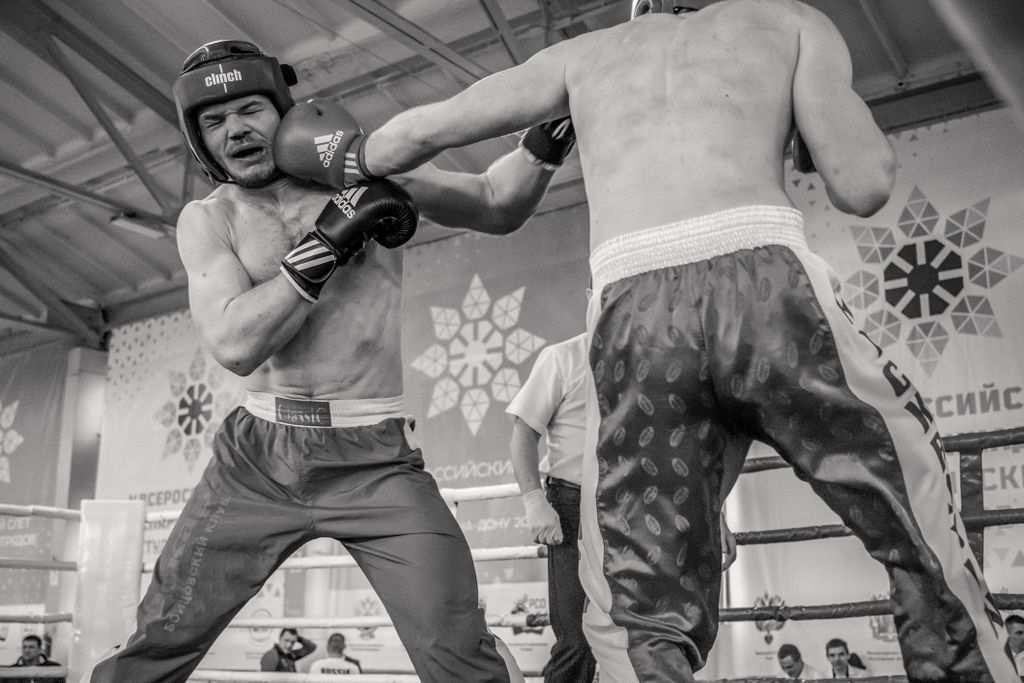
When you train boxing, Brazilian Jiu Jitsu, Muay Thai, judo, wrestling, or another combat sport, you’re continually reminded that your body is still capable of learning, adapting, and doing difficult things.
You feel stronger, more capable, and perhaps most importantly, you develop confidence in your body at an age when many people are beginning to lose it.
Knowing You Can Defend Yourself Still Matters
I don’t train because I’m expecting to get into fights, or even preparing for the possibility. In fact, the older I get, the less interested I am in fighting anyone outside the gym. My first line of defense is always to avoid violent confrontation whenever possible. However, there’s still tremendous value in knowing that if something happens, you have some ability to protect yourself or the people around you.
Self-defense doesn’t necessarily mean dominating an attacker or winning some prolonged street fight. Sometimes it simply means being able to neutralize a threat long enough to get away. It can also mean avoiding dangerous situations or using verbal de-escalation.
My own thinking about this has changed as I’ve gotten older. I spent roughly a decade training Brazilian Jiu Jitsu, and I have enormous respect for its effectiveness. But at this stage of my life, the last place I want to be during a confrontation is rolling around on the pavement with an aggressor.
That’s one of the things I appreciate about boxing. If I can use footwork to stay out of someone’s way, move my head to avoid a punch, or throw a quick combination that gives me enough time and distance to escape, that’s a pretty good outcome.
The objective isn’t to prove how tough I am. It’s to get home safely. And simply walking around with the confidence of knowing that I have skills and a plan may be enough to make me a less appealing potential target.
Confidence Can Be a Form of Self-Defense
There’s another benefit to knowing how to fight that is much harder to quantify. You carry yourself differently.
Someone who has spent years training with resisting opponents generally has a much better idea of what he can and cannot do physically. You don’t need to pretend to be tough because you’ve already tested yourself.
That confidence can affect posture, eye contact, movement, and the way you respond to confrontation. Simply looking comfortable and confident may sometimes make you a less appealing target in the first place.
Of course, confidence isn’t a guarantee of safety, and good judgment and avoidance should always come first. But I’d rather go through life knowing I can handle myself than wondering what would happen if I ever had to.
Don’t Give Up Your Fighting Spirit
For me, the biggest reason men over 50 should learn how to fight actually has very little to do with self-defense. It’s about maintaining a fighting spirit.
As we get older, I think it’s surprisingly easy to start surrendering pieces of ourselves. We become more comfortable, take fewer risks, and avoid things we’re not immediately good at. We can start accepting limitations simply because we’re getting older.
It takes a lot of humility to walk into a fight gym and accept the possibility of feeling and looking like a complete beginner, especially when this can be seen in stark contrast to younger practitioners who are already formidable competitors in their physical prime.
That attitude doesn’t necessarily remain confined to physical activity. It can creep into our careers, our health, and the way we approach difficult periods in our lives.
Learning to actually fight reminds you that struggle is normal. You get tired and keep working. You get frustrated because you can’t execute a technique and come back the next day to practice it again.
Someone younger, faster, or more athletic gets the better of you, and instead of quitting, you figure out what you can learn from the experience.
Those lessons translate surprisingly well outside the gym.
Fighting Helped Me in Business
I saw this very clearly during the pandemic. My wife and I were both laid off at the beginning of COVID. Suddenly, we found ourselves in a situation neither of us had planned for. We needed to figure something out.
At the time, I was heavily involved in Brazilian Jiu Jitsu, while my wife had her own martial arts training background. Looking back, I’m convinced that the fighting spirit we’d developed through martial arts contributed to how we responded.
We didn’t simply accept what had happened. Instead, we built a business out of necessity. It grew quickly, and thankfully it has continued to grow and do well.
Obviously, martial arts wasn’t solely responsible for that success. But I believe the mindset we’d developed through years of training played a meaningful role.
When you’re accustomed to being put in difficult situations and figuring out how to keep going, adversity doesn’t necessarily feel like a signal to stop.
Sometimes it simply feels like a problem that needs to be solved.
Getting Uncomfortable Is Good for Us
There’s another reason I think learning to fight becomes increasingly valuable as we age. It forces us out of our comfort zones.
Modern life makes it incredibly easy to avoid discomfort, particularly as we become more established in our careers and routines. You can spend your evenings on the couch and your weekends watching television. You can stick with the things you’re already good at. You can gradually eliminate physical and intellectual challenges from your life.
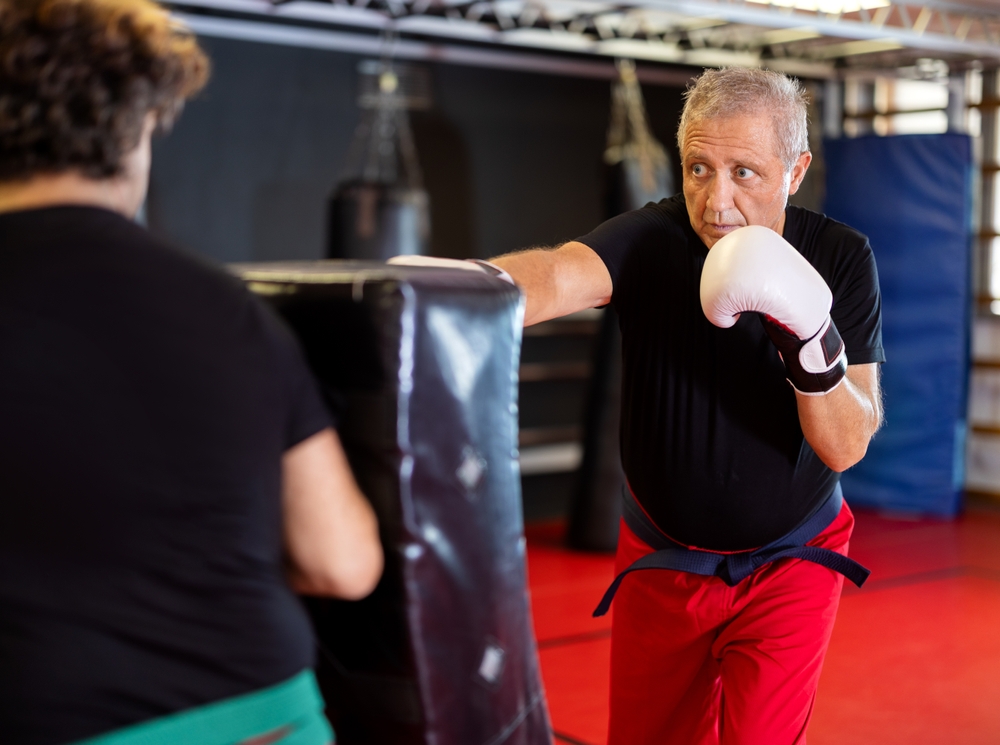
Martial arts doesn’t allow that. Walk into a boxing gym for the first time and you’re going to feel awkward. Your feet won’t cooperate with your hands, you’ll forget combinations, and you’ll get tired faster than you expected. You’ll discover that hitting a heavy bag properly is considerably more complicated than it looks. But eventually, the techniques begin to click, and you realize that you’re acquiring a new skill.
That’s an important process at any age, but I think it’s particularly valuable after 50. I have a close friend from childhood who, in his 50s, still wrestles and boxes with his grown sons. Aside from the close bond this helps promote between him and his sons, he has a much more youthful energy than most of his peers, and his passion for life and for his life’s purpose shines through quite clearly.
I notice this not just with him, but with nearly all of the other middle-aged combat sport athletes I know.
Learning to Fight Keeps You Learning
Martial arts also requires an enormous amount of learning.
Boxing alone involves footwork, balance, timing, distance, combinations, defense, head movement, rhythm, and countless other skills that have to work together. Additionally, the mechanics are quite detail-oriented, and small details such as a pivot or a turn of the wrist can have a tremendous impact on the effectiveness of a punch.
Brazilian Jiu Jitsu may be even more complicated. You’re constantly learning positions, transitions, escapes, submissions, and ways of solving problems against another person who is simultaneously trying to solve the problem you’re presenting to them. This is all being done while in positions that can be quite unnatural for human beings, especially for someone in their mid-50s.
This type of continuous skill acquisition challenges the brain as well as the body.
That’s one reason I’ve become so interested in the relationship between martial arts and neuroplasticity as I’ve gotten older. We’re asking our brains to learn new movement patterns, coordinate multiple actions, react to changing situations, and continually refine skills.
Instead of deciding that we’re too old to learn something difficult, we’re proving the opposite several times a week.
Keep the Old Man Out
None of us can stop aging, and learning how to fight isn’t going to make a 57-year-old move exactly like he did at 25. But that’s not the point. The goal is to preserve as much capability, curiosity, confidence, and fighting spirit as we can for as long as possible.
For me, martial arts provides a reason to stay strong and something difficult to work toward. It also keeps me learning and reminds me that I’m still capable of improving. And perhaps most importantly, it provides an antidote to the idea that getting older means gradually retreating from difficult things.
I’d much rather spend part of my afternoon learning how to throw a better combination, improving my footwork, or challenging myself physically than simply sitting in front of the television waiting to get older.
You don’t have to become a professional fighter, and you don’t even have to compete. But I think there’s something extraordinarily valuable about reaching your 50s and knowing that you’re still willing to step into a gym, learn how to fight, and discover what you’re capable of.
Maybe that’s one of the best ways we have to keep the old man out.