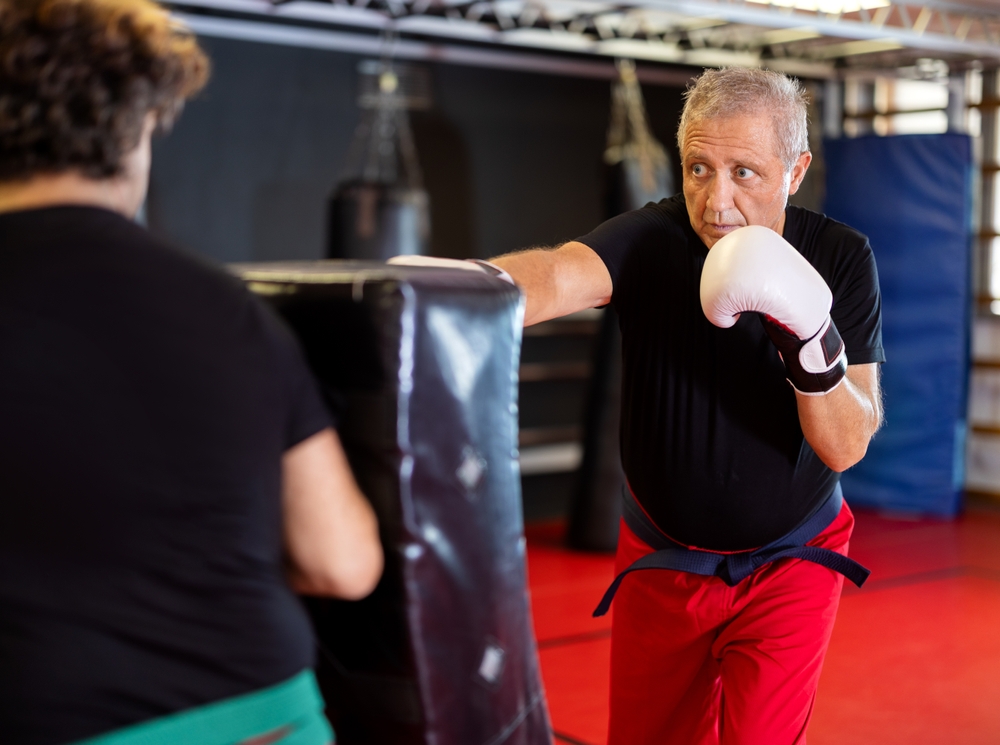

If you’re over 50 and thinking about starting boxing training, you’re not alone, and you’re definitely not too late.
In fact, if you approach it the right way, boxing can be one of the most effective, enjoyable, and sustainable training methods available at this stage of life.
But there’s a catch. Most beginner advice is written for people in their 20s. If you follow that approach (jumping rope endlessly, going full power on the heavy bag, pushing through fatigue, etc), you’re much more likely to get hurt than to get better.
What works over 50 is different. Here’s how to do it the right way.
Start With Skill, Not Intensity
One of the biggest mistakes beginners make is trying to “feel like a boxer” right away.
That usually means hitting the heavy bag too hard, moving too fast, and getting exhausted within minutes, all of which create a perfect recipe for injury.
Instead, think of your first few months as skill acquisition. Focus on your stance and balance, basic punches (jab and cross), breathing, staying relaxed, engaging the core, and drilling the mechanics of your punches by learning to properly recruit the entire kinetic chain.
When I started, I kept most of my heavy bag work at about 50–60% intensity. That alone made a huge difference not just in avoiding injury, but in actually improving technique.
Protect Your Lower Legs Early
Jump rope is one of the best tools in boxing, but it’s also one of the easiest ways to develop nagging injuries if you ramp up too quickly.
Common issues include shin splints, calf tightness, and achilles irritation. I learned this the hard way as my jump rope skills gradually improved. As I began to introduce more jumping on one foot, slightly greater volume, and integrating the boxer skip, I began to notice soreness in my right calf and had to stop jumping rope for a full week.
If you’re just starting, consider using a slightly thicker PVC rope such as the Swissskip Speed Jump Rope, which is generally much more forgiving than a speed rope. Try to stay low to the ground (no more than about 1-2″), keep your sessions relatively short (about 30-60 seconds at a time initially), and build your volume gradually.
If something starts to feel “off,” that’s your signal to back off, not to push through. I’ve also found it helpful to do calf stretches between rounds to keep things loose and relaxed.
Keep Your Power in Check
You don’t need to hit hard to get a great workout. In fact, learning to control your power is one of the most valuable skills you can develop early on.
Working at moderate intensity will reduce joint stress, improve technique, and will build endurance more safely. You can always layer in power later. It’s much harder to undo bad habits or to recover from injury. This will also have the added benefit of helping you to learn proper technique from the start.
Build a Simple Weekly Structure
You don’t need a complicated program to make real progress. Boxing training is built on repetition and “getting in the reps”. I’ve discovered that I love the repetitive and meditative aspect of it.
A simple structure works extremely well:
2–3 boxing sessions per week
- Shadowboxing
- Light heavy bag work
- Basic drills (head movement, footwork, etc)
2 strength sessions
- Pushups
- Squats
Daily movement
- Walking or rucking
- Light mobility work and gentle calisthenics
Consistency matters far more than intensity. I’ve found that daily calisthenics have been incredibly helpful in my training, and this also eliminates the need to squeeze in high rep counts on strength days, thus making my training far safer and less taxing on the body.
Pay Attention to Recovery Signals
Over 50, your body gives you feedback, but just need to listen to it. Watch for persistent soreness (especially in calves or shoulders), tightness that spreads (calf → hamstring → glutes), and sharp or unusual sensations.
These aren’t setbacks. They’re actually guidance. When you feel any of these sensations, take it as a cue to modulate your intensity or volume.
When I feel something coming on, I’ll shift to shadowboxing instead of bag work, walking or rucking instead of jumping rope, or lighter strength work. While I was recovering from my tight calves from jumping rope, I would warm up on the stationary bike instead of jumping rope. This got the blood pumping, primed the muscles, and had the added benefit of relaxing both the calf muscles and the hip flexors.
That adjustment is often the difference between staying consistent and being forced to stop due to injury. I always am mindful of recovery and do my best to be just as disciplined about it as I am toward my boxing and strength training.
Don’t Rush the Process
Boxing is a long game. The goal isn’t to feel like a fighter in your first month, but rather to still be training, improving, and enjoying it a year from now.
If you stay patient, your conditioning will improve, your technique will sharpen, and your confidence will grow. And most importantly, you’ll stay healthy enough to keep going.
Final Thoughts
Starting boxing training over 50 isn’t about limitations. Instead, it’s about taking the right approach.
Train smart by focusing on skill acquisition, controlling your intensity, progressing gradually, and respecting recovery. If you need to adjust your training circuit to account for injuries or sore muscles, it’s very easy to do so. I’ve found at my boxing club that the trainers are extremely understanding of anyone who needs to make adjustments to their routine for these reasons. I’ll sometimes alert the coach if I plan to make an adjustment just so they understand why I’m altering my routine. They often appreciate knowing this, and they can appreciate when someone is continuing to put in the work even if it means modifying the circuit to accommodate an injury.
If you’re wondering what essential gear you’ll need to keep in your boxing gear bag, check out our post on the equipment we recommend for all beginning boxers over 50.
Do that, and boxing won’t just be something you try briefly. It’ll become something you can do for years. I’m finding that I’m enjoying my boxing training so much that even once I return to BJJ, I expect to continue my boxing training as well.
To view the Swissskip Speed Jump Rope on Amazon, click here.
BudoBelly is a participant in the Amazon Services LLC Associates Program, an affiliate advertising program designed to provide a means for us to earn fees by linking to Amazon.com and affiliated sites.