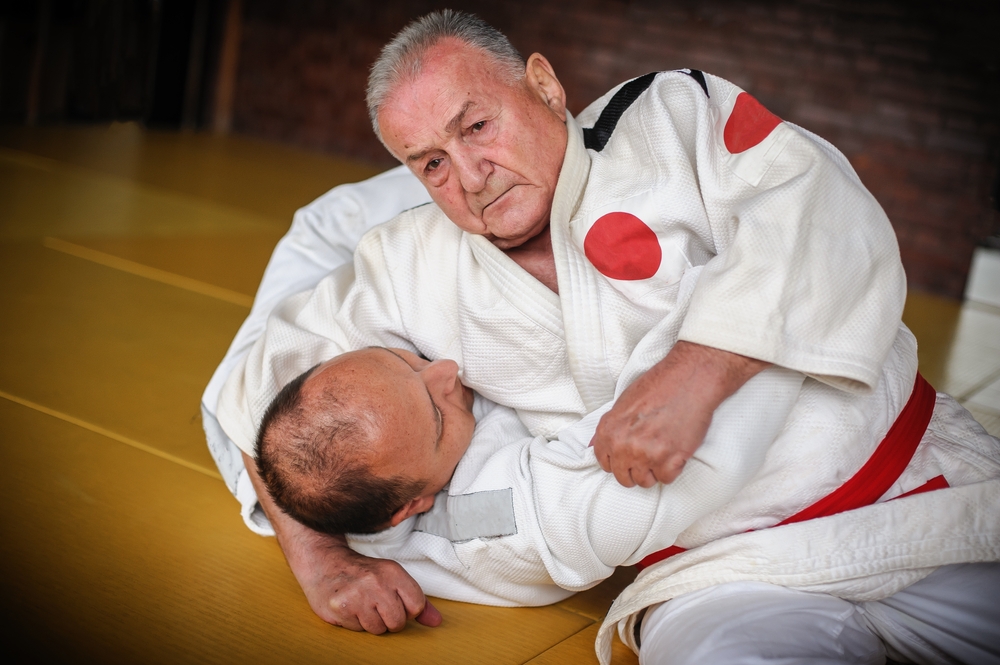
When I first began training combat sports in my early forties, I would do everything possible to keep up with my younger teammates. It worked for years, but once I reached my fifties, my age caught up to me and I quickly realized that I needed to adjust my training accordingly. It didn’t mean that my training needed to become less effective. It just meant that I couldn’t rely anymore on just pushing through my training. I needed to train thoughtfully, intelligently, and with purpose.
The Goal Isn’t Maximum Training
Many athletes think in terms of more rounds, more lifting, and more conditioning, and making it hard all the time.
Instead, the goal is maximum recoverable training. Once over 50, the sweet spot is to train hard enough to force adaptation while still being able to recover before your next session.
Younger Athletes Recover Differently
Athletes in their 20s are able to spar several times per week, or to make every roll in BJJ a competition pace. They can also lift heavy regularly, recover overnight, and tolerate accumulated fatigue.
Whereas after 50, connective tissue recovers more slowly, sleep becomes more important, fatigue accumulates, and small aches linger longer. This isn’t a weakness. It’s simply physiology. I used to find it easy to be pushed into training harder than my body is capable while training BJJ with much younger teammates, especially since I’m often mistaken for someone much younger than my chronological age, so I have a lot of experience with coaches pushing me as hard as they do for athletes half my age.
Your Body Gives You Feedback
This is where your experience becomes valuable. Instead of following someone else’s schedule, pay attention to motivation, soreness, joint stiffness, explosiveness, sleep quality, and desire to train. If several of these decline simultaneously, recovery may be the limiting factor, and not fitness.
In addition to recovery, look at your nutrition and hydration. The type of nonstop training without regard for nutrition that younger athletes can tolerate doesn’t apply to older practitioners. For those of us over 50, it’s essential to eat a nutrient dense diet rich in protein and to remain hydrated. Many people also find that supplementing with creatine and collagen peptides helps with recovery and tolerance for high physical demands of combat sports.
The Sweet Spot
For older boxers and grapplers, the sweet spot can often be found in finishing sessions feeling like you could have done one or two more rounds. Instead of leaving the gym exhausted every workout, aim to leave feeling challenged but capable of returning in another day or two.
Consistency beats occasional heroic workouts. While it’s perfectly appropriate to enjoy some hard rounds or strenuous workouts from time to time, this shouldn’t be the norm. Push yourself just enough to get a stimulus or to prepare for an upcoming competition, but make the primary focus of your training skill acquisition and improvement. You don’t need to make every round a competition in order to improve in your chosen combat sport.
Hard Days Should Be Hard
This is important. Many people drift toward advising practitioners over 50 to avoid intensity. I’d argue the opposite.
While it may seem to contradict the previous paragraphs, it’s important to keep hard days genuinely hard and to include some intense sessions. However, older combat sports athletes can only do this by also reducing unnecessary volume and allowing sufficient recovery time afterward.
Instead of getting five mediocre sessions in a week, aim for three excellent ones. Make your training deliberate and purpose driven. If you’re going to include some hard sessions, do so with a purpose. Are you preparing for a competition? Are you just looking to test yourself? Do you need this bump in intensity to workshop a position or combination you’ve been working on?
You should be able to explain why you want to train harder and with more intensity, and keep that goal in the forefront of your mind while training in order to avoid pushing your body so hard that you’re unable to return for another training session that week.
Recovery Is Part of Training
As I mentioned in another post, a wise coach once told me that it’s absolutely essential to be as disciplined with recovery as with training.
This means making sure to get adequate sleep, ideally seven to eight hours of quality sleep per night. This may mean developing a sleep hygiene routine or even taking the occasional CBD gummy if needed.
It’s also critical to dial in nutrition by focusing on foods that are natural and not processed, and even better if it’s possible to include meal prep. I also like to include a variation of intermittent fasting, which for me means starting my day with water (and eventually coffee), but delaying my breakfast until around 10:00 or 10:30am. By doing this, I find myself craving snacks far less during the day, I feel more satisfied, and I’m able to finish eating by around 6:30 or 7:00pm each day. By compressing my eating window, I also manage to easily stay within my caloric intake goals to maintain a caloric deficit, and I can do so quite easily as I feel very full and satisfied during my eating window.
Another critical element for older athletes is including daily walking and mobility. I’ve found that when I begin every day with some mobility and light calisthenics along with walking about 1,000 steps first thing in the morning, it sets me up for success throughout the rest of the day and helps to prime my body for the day’s activities.
It certainly helps to take in a sufficient amount of protein and to remain hydrated. I aim for about 1.5 to 2 grams of protein for every kilogram of bodyweight, and I get this from multiple sources including nonfat Greek yogurt, various types of nuts, hard boiled eggs, a variety of animal protein, and the occasional piece of tofu.
As older combat sports athletes, the final piece of the plan involves stress management. As combat sport athletes in our 50’s, most of us have responsibilities to our families and careers as well as the everyday demands of managing our lives. I find that setting aside time at the end of each day for quiet prayer and some reading, taking a walk in the park, and even focused training itself are all valuable tools for stress management, though everyone will gravitate toward their own tools.
What My Training Looks Like
I generally do some form of exercise or movement everyday, though it can vary dramatically in length and intensity. Here’s what my week generally looks like:
5-6 Days per week: Mobility and light stretching, some light bodyweight exercises, light kettlebell cleans, and some core work.
3 Days per week: Strength training. Full body workout focusing mostly on compound movements using kettlebells and bodyweight movements.
3 Days per week: Boxing training. I’ll do a traditional boxing circuit including jump rope, footwork, head movement, shadowboxing, heavy bag work, and some partner drills.
Everyday: I aim to walk at least 7,000 to 8,000 steps each day, and more than 10,000 if possible. I also stretch throughout the day to counteract the effects of sitting at my desk.
While I don’t purposefully program deload weeks, they tend to happen naturally due to travel or life responsibilities. This way, I don’t stress if my schedule prevents me from getting in my regular workouts. The worst case scenario is that I’ll do pushups, squats, and planks throughout the day along with as much walking as I can do. This enables a natural deload and makes it easy to continue training during these periods.
I find that this schedule allows me to build sufficient strength for what I need to do, keeps me moving athletically, doesn’t overload my body, leaves enough in reserves for when I do want to push to my limits, and allows for plenty of recovery time.
Signs You’re Training Too Hard
If you find that you’re training too hard or not getting enough recovery, the signs are usually quite obvious. Some common effects of overtraining are persistent soreness or declining performance. You may lose some explosiveness or your reaction time might suffer. You may find yourself prone to nagging injuries, or you may just feel sore all the time.
One very obvious sign that I’ve experienced is feeling tired and lethargic, almost as if I have a flu. This is often accompanied by a craving for carbs.
Some people also report a decline in athletic performance, irritability, poor sleep, and even dreading training. But when you find the right balance, it’ll be quite obvious.
Signs You’ve Found the Right Balance
If you’ve found the right balance, you won’t see anything dramatic. Instead, you’ll see slow and steady gains that will happen simply by maintaining your regular routine.
You’ll steadily improve, you’ll feel motivated, and you’ll have minimal soreness. You can also expect to see improvements in technique, fewer injuries, and you’ll find yourself showing up to train without having to force yourself.
In other words, you won’t see anything flashy or groundbreaking. Instead, your training will just happen and will integrate into your lifestyle quite naturally.
Conclusion
One of the biggest lessons I’ve learned from training combat sports in my fifties is that the goal isn’t to prove how hard you can train. It’s to build a routine you can sustain for years.
The athletes who continue improving into their sixties and beyond aren’t usually the ones who trained the hardest in any given week. They’re the ones who kept showing up, month after month, because they respected recovery just as much as effort.

Great article! I really liked the emphasis on maximum recoverable training rather than just pushing to total exhaustion. The idea of finishing a session feeling like you could do one or two more rounds is a fantastic rule of thumb for longevity in martial arts.
Thank you for the feedback! While pushing to total exhaustion may have been possible for some of us 20 or 30 years ago, I’m more interested in being able to train the next day. Glad to know that you enjoyed the post and thank you for reading!
Glad you enjoyed the post! As much as I love to push to the extremes with training, after age 50 it’s just not sustainable anymore. I sure miss the days when I could train until total exhaustion, but being able to return to train again the next day is a far better option than nursing an injury.
Can your team plan three sessions around recovery; deliberate volume stays sustainable.
Sure, I’d be glad to do so. Can you be more specific? Are you looking for a plan for your recovery day, or exercises to include to assist with recovery on any day?
I’m not a personal trainer, but have lots of experience planning sessions which have been very effective, and would glad to help you with this.
This really hits home – I’ve been trying to keep up with the 20-somethings at my gym and feeling it the next day. You’ve got to size it up differently as you get older, listening to your body instead of pushing through pain. Training smarter has definitely helped me stay consistent without burning out.
Absolutely – you’ve got the right idea! I don’t know about you, but it took me quite some time to understand that I needed to adjust my training. Glad you’ve figured out how to reconcile training a combat sport with the effects of aging.