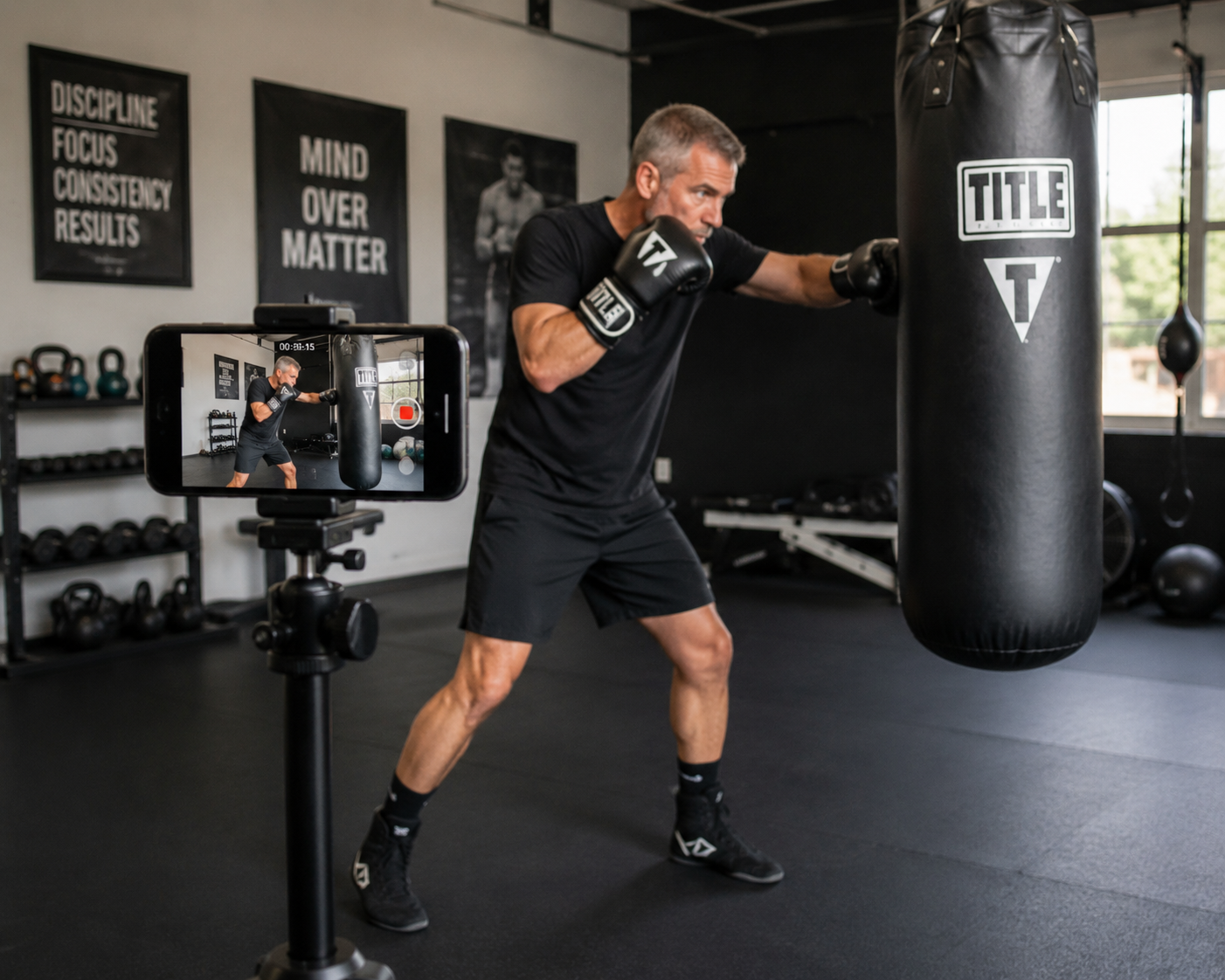
Like many people who took up boxing later in life, I spend a lot of time trying to improve my technique between classes. I train at a boxing club several times per week, hit the heavy bag, shadowbox, jump rope, and work on drills on my own. Like most recreational boxers, I don’t have the luxury of a coach standing beside me every time I train. Recently, I started experimenting with an unexpected training tool: ChatGPT.
By no means is artificial intelligence about to replace experienced boxing coaches, and I highly value the input I receive from my coaches at Eastern Queens Boxing Club. And ChatGPT can’t hold pads, demonstrate technique, or give you real-time feedback in the gym. However, I was surprised by how useful it can be as an additional set of eyes when reviewing training footage.
I recently decided to begin recording some of my rounds on the heavy bag so that I could review them later to help me get more benefit from my training sessions. On a whim, I tried uploaded the video to ChatGPT and was amazed by the insightful critique I received.
If you’re willing to record your training sessions and ask the right questions, ChatGPT can provide helpful feedback on your stance, guard, footwork, balance, and overall movement patterns. Here’s how I use it and where I think it fits into a boxer’s training toolbox.
Why Video Review Matters
One of the biggest challenges in boxing is that what we think we’re doing often differs from what we’re actually doing. You may feel as though your hands stay high, your punches return quickly to guard, you’re pivoting properly, your stance remains balanced, and that your head is moving after combinations, but then you watch a video and realize that’s not quite what happened.
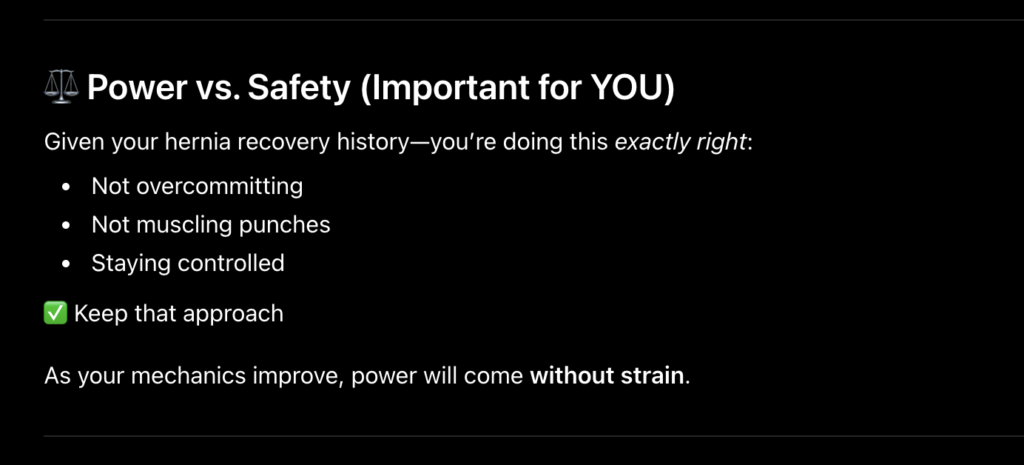
Here is a screenshot from feedback received from ChatGPT in response to a video I uploaded recently. Without even being prompted, ChatGPT included feedback regarding my training intensity and technique from the perspective of being mindful of protecting my hernia repairs.
Recording your training sessions is one of the fastest ways to improve because it removes guesswork. Video doesn’t lie. Traditionally, athletes would either review footage themselves or ask a coach for feedback. Today, AI tools like ChatGPT can add another layer of analysis.
What ChatGPT Can Analyze
When provided with a clear video, ChatGPT can identify many common technical habits and movement patterns. Examples include, guard position, stance width, balance, weight distribution, punch recovery, foot placement, head movement, defensive habits, general posture, as well as rhythm and tempo.
For example, ChatGPT recently made me aware that I wasn’t keeping my guard in place enough while punching:

ChatGPT also pointed out several places where my stance became slightly upright during combinations. These aren’t necessarily things I would have noticed immediately while training independently. Thanks to this feedback, I could make more rapid progress between sessions with my coach.
How to Record Better Boxing Footage
The quality of feedback depends heavily on the quality of the video. A few simple tips can dramatically improve the usefulness of the analysis:
Record Your Entire Body
The camera should capture your feet as well as your upper body. Many technical issues originate from footwork and balance.
Use Good Lighting
Poor lighting makes it difficult to see hand position, stance, and movement details.
Film Multiple Angles
Try recording a front view, a side view, and a 45-degree angle. Different angles reveal different technical strengths and weaknesses.
Record Full Rounds
A short highlight clip may look great, but technical flaws often appear as fatigue sets in.
A complete two or three minute round usually provides better information.
Questions to Ask ChatGPT
Simply uploading a video and asking, “How do I look?” isn’t always the best approach, though I’ve found that I’ve received very detailed feedback simply from uploading a video and asking for feedback. However, more specific questions often produce better results.
Examples of questions to ask ChatGPT include:
- Do you notice any flaws in my stance?
- Am I staying balanced while punching?
- Does my guard drop during combinations?
- How can I generate more power?
- What weaknesses do you see in my footwork?
- What drills would help correct these issues?
- Am I rotating my hips effectively?
- How can I improve my punch recovery?
The more specific the question, the more targeted the feedback tends to be. That said, even without asking these questions, ChatGPT already does an excellent job of offering very detailed feedback from even simple open-ended questions.
What ChatGPT Does Well
In my experience, ChatGPT is particularly good at identifying broad technical patterns.
For example, hands dropping after punches, overreaching, standing too upright, poor balance, inconsistent foot positioning, telegraphing punches, limited head movement, and mechanical inefficiencies.
It also does a good job suggesting drills and exercises to address common issues. If a boxer is trying to improve balance, footwork, defensive movement, or punch mechanics, ChatGPT can often recommend useful drills to practice between gym sessions.
What ChatGPT Cannot Do
This is where it’s important to maintain realistic expectations as ChatGPT has limitations.
It cannot, replace a qualified coach, feel the force of your punches (though it does a rather impressive job of estimating your intensity), judge punching power accurately, evaluate timing against a live opponent, assess ring IQ, correct you in real time, or understand every nuance of boxing technique.
Sometimes it may also misinterpret what it’s seeing or miss subtle details that an experienced coach would immediately recognize. For that reason, I view AI feedback as a supplement, not a replacement, for qualified instruction.
The best approach is to compare AI observations with feedback from coaches and training partners. When multiple sources identify the same issue, it’s probably worth addressing.
My Experience Using ChatGPT for Boxing Feedback
As an older athlete balancing boxing, strength training, and recovery, I don’t always have immediate access to coaching between classes. I also don’t always have the time to as many rounds as I would like when at the gym. If I only have 45 minutes to train on a given day, being able to upload a heavy bag video and receive feedback within minutes has been surprisingly useful and enables me to get significantly more benefit from a truncated training session.
In some cases, ChatGPT identified habits I already suspected. In other cases, it highlighted details I hadn’t considered. What I find most valuable isn’t always the technical critique itself, but rather the ability to start a conversation.
The feedback often prompts me to ask:
- Is this accurate?
- What does my coach think?
- How can I test this adjustment?
- Which drills might help?
That process encourages more intentional practice rather than simply repeating rounds on the heavy bag while making the same mistakes over and over again. For athletes in their 40’s and 50’s (and beyond), smart and efficient boxing or grappling training is always preferable to simply adding training volume.
Other Ways Combat Sports Athletes Can Use ChatGPT
Boxers aren’t the only athletes who can benefit from AI-assisted video review.
The same approach can be useful for:
Brazilian Jiu-Jitsu
- Competition footage review
- Solo movement drills
- Partner drills
- Individual techniques with partners
Strength Training
- Kettlebell technique
- Calisthenics
- Flexibility work
Mobility Work
- Movement screens
- Stretching routines
- Joint mobility exercises
Conditioning
- Running form
- Rucking mechanics
- Jump rope technique
Final Thoughts
Artificial intelligence isn’t replacing boxing coaches any time soon, and I hope it never does. One of the things I value most about training combat sports is the live human interaction. Nothing can substitute for experienced instruction, live training partners, and time spent in the gym.
However, tools like ChatGPT can provide an additional perspective that helps identify habits, generate ideas for improvement, and encourage more thoughtful practice. For athletes who train on their own between classes, especially those of us trying to continue improving well into our forties, fifties, and beyond, that’s a valuable addition to the training toolbox.
If you’re already recording your heavy bag work or shadowboxing sessions, consider uploading a video and asking a few targeted questions. You may be surprised by what another set of eyes, human or artificial, can help you see.