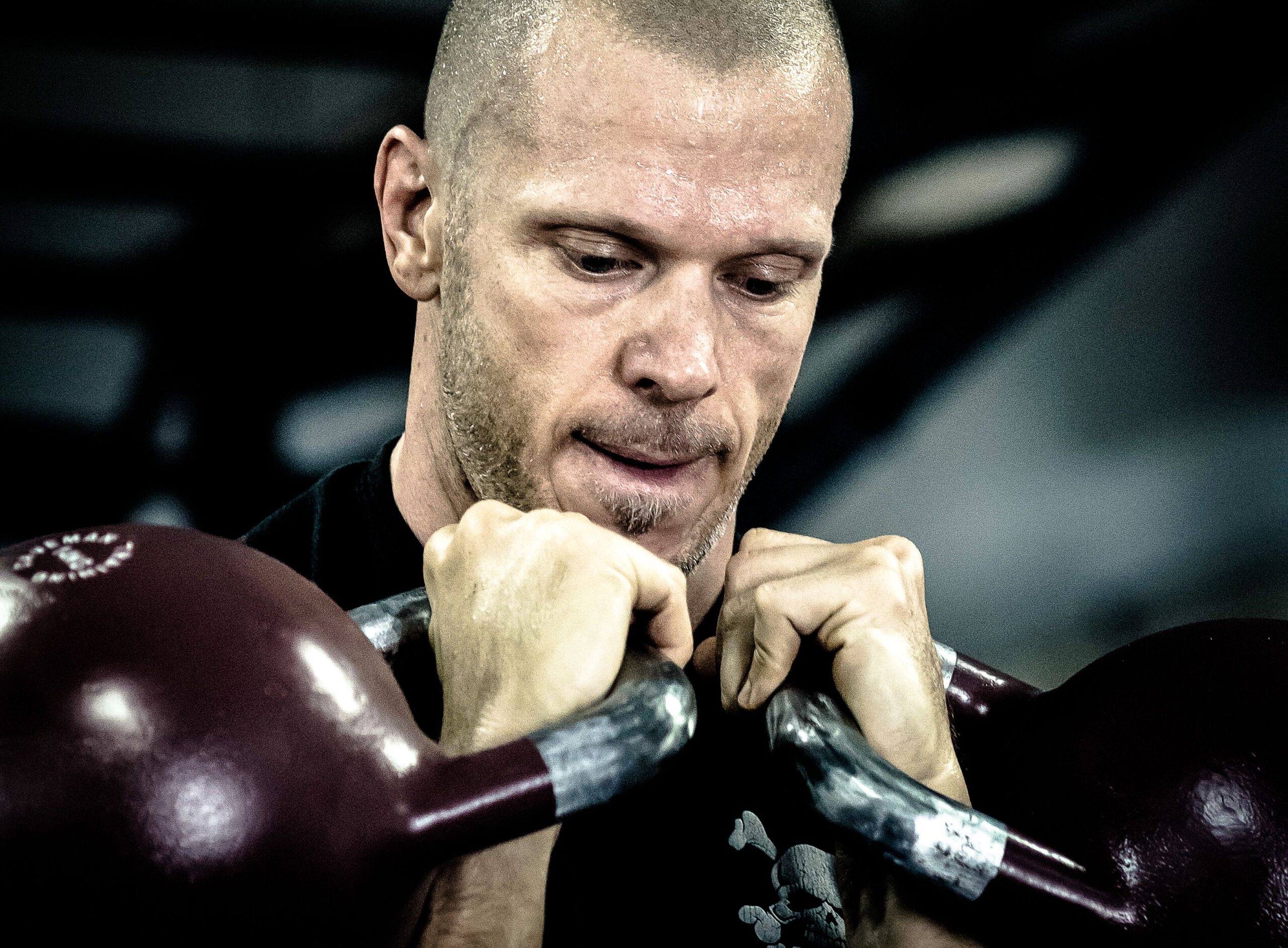
As I’ve gotten older, I’ve become much more interested in training methods that give me a high return on investment without unnecessarily beating up my body. I still aim to be strong and explosive, and I want to incorporate conditioning that carries over to boxing, Brazilian Jiu Jitsu, and everyday life.
But after 50, I’ve also had to think about something I didn’t spend nearly as much time thinking about when I was younger: Can I keep doing this for years?
That’s one of the reasons I’ve become such a fan of kettlebell training. I first learned about kettlebells over 20 years ago from an acquaintance who had begun using them, and I became intrigued by the concept of using such a simple tool that can have such profound benefits.
I’ve since trained extensively with kettlebells over the years, including working with qualified StrongFirst instructors, and I’ve found kettlebells to be one of the most practical strength-training tools available for martial artists, especially those of us training in our 40s, 50s, and beyond.
They don’t require a complicated program, a huge collection of equipment, or hours in the gym. A small number of fundamental movements can develop strength, power, conditioning, coordination, and core stability while complementing rather than replacing martial arts training.
Here are some of the reasons I think kettlebell training is particularly well suited to martial artists over 50.
Kettlebell Training Rewards Good Technique
One of the things I appreciate most about kettlebell training is its emphasis on technique. I’ve always been fascinated by technique and mechanics, whether in how I approached playing a musical instrument or in exercise, so the emphasis on proper technique in the kettlebell community spoke to me from the very start of my fitness journey.
A kettlebell swing isn’t simply picking up a weight and swinging it around. A good swing requires a properly executed hip hinge, appropriate tension and relaxation, strong core engagement, breathing, timing, and control. There are countless videos of trainers performing swings incorrectly, with the most common mistakes being to squat instead of hip hinge, or to use the arms to lift the kettlebell instead of the snap from the explosive hinge.
The same attention to detail in the technique is also true of cleans, presses, squats, Turkish get-ups, and other kettlebell movements.
That should sound familiar to martial artists.
In boxing, throwing harder punches isn’t simply a matter of trying harder. Technique allows you to produce more force efficiently. The same principle applies to Brazilian Jiu Jitsu. Good mechanics can allow a smaller or older practitioner to accomplish something that brute force alone cannot.
Kettlebell training operates on much the same principle.
Learning proper technique also encourages intelligent progression. Rather than constantly chasing heavier weights, you can become stronger by improving your movement, gradually increasing repetitions and training volume, and only progressing the load when you’re ready.
For older athletes, I think that’s particularly important.
Muscles aren’t the only tissues that need to adapt to training. Tendons, ligaments, connective tissue, and joints all need time to become accustomed to increasing loads. Gradual progression can help build a more resilient body while reducing unnecessary injury risk.
At this stage of my life, I’m much more interested in building strength I can actually use and keep rather than proving how much weight I can move on any particular day.
Kettlebells Are Built Around Compound Movements
Many of the fundamental kettlebell exercises involve the entire body.
Consider movements such as:
- Kettlebell swings
- Goblet squats
- Turkish get-ups
- Cleans
- Presses
- Deadlifts
- Loaded carries
These aren’t exercises that isolate one small muscle while the rest of the body remains stationary. They require multiple muscle groups to coordinate with one another. That’s particularly appealing for martial artists because martial arts are inherently full-body activities. A punch doesn’t come exclusively from your arm. Power travels from the floor through your legs and hips, through your trunk, and ultimately through your fist.
A takedown, scramble, bridge, or technical stand-up similarly requires multiple parts of the body to work together. Compound kettlebell exercises train the body in much the same way: as an integrated system. This helps to make kettlebell training an excellent complement to martial arts training, especially when viewed through the lens of how the two relate. A primary example of this is how performing kettlebell swings or cleans helps me to connect and understand how to recruit the kinetic chain better during boxing.
Kettlebells Train Movements We Actually Use
Another thing I like about kettlebells is that many of the basic exercises resemble natural human movement patterns. As humans, we squat, we hinge at the hips, we pick things up, we carry things, we push, we pull, and we get up from the ground.
These patterns matter in martial arts, but they also matter in everyday life. Maintaining the ability to squat, hinge, carry weight, get off the floor, and stabilize yourself under load becomes increasingly important as you age.
For me, that’s one of the biggest differences between training simply to look fit and training for longevity. I don’t just want muscles that look strong. I want a body that remains capable and will continue to serve me well as I grow older.
If kettlebell training helps me continue boxing, return to the mats, carry luggage, move furniture, climb stairs, pick things up from the floor, and remain physically independent as I get older, that’s an enormous return on investment from my training time.
Kettlebells Demand Core Stability
Almost every properly performed kettlebell exercise requires significant core involvement. That’s true whether you’re swinging a kettlebell, carrying one, pressing it overhead, performing a goblet squat, or moving through a Turkish get-up.
Your core isn’t simply there to produce visible abdominal muscles. Its more important role is stabilizing the trunk and allowing force to transfer efficiently between the upper and lower body, and that matters tremendously in martial arts.
Punching requires force transfer through the trunk. Grappling requires you to stabilize your body while someone else is actively trying to move it. Even basic footwork requires the torso and pelvis to remain controlled as the limbs move around them.
Kettlebell training teaches you to create tension when you need it while continuing to move and breathe, which is an extremely useful skill for combat sports.
Kettlebell Workouts Can Be Extremely Time Efficient
One of the realities of being an older recreational martial artist is that training isn’t the only thing happening in your life.
Most of us aren’t professional athletes. We have careers, families, and other responsibilities. And we’re already trying to fit boxing, BJJ, Muay Thai, or another martial art into the week. That makes strength training difficult to program if every workout requires driving to a gym and spending 90 minutes working through a long list of exercises.
Kettlebells offer another option. A relatively short workout involving swings, squats, presses, carries, or Turkish get-ups can train a tremendous amount of the body. Even 15 to 30 minutes can be productive.
That makes kettlebells particularly useful as supplemental strength training for martial artists. The goal isn’t necessarily to turn kettlebell training into another sport requiring five workouts per week. It’s to get stronger and more resilient so that we can continue doing the sport we actually love.
Over the years, I’ve developed a system for integrating my kettlebell and bodyweight training into my daily schedule. Between my morning mobility and bodyweight work combined with short kettlebell complexes in my office throughout the day, I’m able to easily integrate a full workout in a way that doesn’t tax the body or my schedule too much. Kettlebell guru Pavel Tsatsouline calls this “greasing the groove” in his seminal work Simple & Sinister, in which he discusses at great length the benefits of spreading out sets throughout the day to enable the practitioner to be fresh and in perfect form for every set and rep.
You Can Train Almost Anywhere
Another major advantage is convenience.
You don’t necessarily need a gym membership, you don’t need a squat rack, nor do you don’t need a room filled with machines. You don’t even need much space. I actually keep several kettlebells in my office. That means I can fit a short strength session into my day without driving anywhere or reorganizing my entire schedule.
You can keep kettlebells at home, in a garage, in an office, or practically anywhere you have enough room to train safely.
For someone balancing work, family, and martial arts training, removing the commute to the gym can make the difference between strength training consistently and not doing it at all.
Kettlebell Training Can Be Surprisingly Inexpensive
Strength training can become an expensive hobby.
Gym memberships add up. Home gyms can cost thousands of dollars. Racks, barbells, benches, plates, machines, and other equipment require both money and space.
Kettlebell training can be remarkably simple by comparison. You can accomplish an enormous amount with one kettlebell, and two appropriately selected kettlebells can provide even more room for progression. And unlike a gym membership, a good kettlebell can potentially last for decades.
That makes kettlebells one of the more cost-efficient ways I’ve found to build a practical strength-training setup. For the cost of one or two months of many gym memberships, it’s possible to assemble a home gym setup that covers everything that’s needed to build incredible strength, mobility, and longevity.
Kettlebells Should Support Your Martial Arts Training
For martial artists over 50, I think it’s important to remember what supplemental training is supposed to accomplish.
If boxing is your sport, strength training should help you box. If BJJ is your sport, strength training should help you stay on the mats. You should be learning and reinforcing how to recruit the kinetic chain, strengthening the core, developing mobility, and building strong tendons and ligaments.
The goal shouldn’t be to create so much fatigue or soreness in the weight room that you can’t perform well during martial arts training.
That’s another reason I like kettlebells.
A relatively minimalist program can provide a great deal of strength and conditioning without requiring bodybuilding-style workouts involving dozens of sets or lengthy gym sessions.
The exact exercises and volume will depend on your experience, physical condition, martial art, injury history, and goals. Someone new to kettlebells should also consider getting instruction from a qualified coach before attempting more technical ballistic exercises such as swings, cleans, or snatches because when it comes to kettlebells, technique matters.
And after 50, I think intelligent progression matters even more.
Strength for the Long Game
My priorities have changed as I’ve gotten older.
I’m no longer interested in strength simply for the sake of putting bigger numbers on a bar. I want strength that allows me to keep training. I now have more specific goals such as wanting strong hips and legs, a stable trunk, healthy shoulders, strong connective tissue, and enough power and conditioning to perform well in combat sports.
And most importantly, I want to remain capable for as long as possible.
Kettlebells aren’t magic, and they certainly aren’t the only effective way to strength train.
But they combine several qualities that make them particularly useful for older martial artists: strength, power, coordination, core stability, natural movement, efficiency, affordability, and convenience.
For those of us trying to balance martial arts with careers, families, recovery, and the realities of getting older, that’s a difficult combination to beat.
The goal isn’t just to be strong today.
It’s to build the kind of strength that helps us keep doing what we love tomorrow, and hopefully for decades to come.